

Vietnam’s economic miracle over the past decade has rested on a fairly simple equation: multinational corporations found it cheaper and politically safer to assemble goods in Vietnam and export them to America, rather than doing so in China.
Samsung has invested more than US$23 billion in factories across Vietnam. Apple also chose Vietnam for the first product line it had ever manufactured outside China from the very first launch phase. Vietnam’s exports to the United States reached US$153 billion in 2025, generating a trade surplus of more than US$130 billion. The entire model was built on one assumption: that U.S.–China trade tensions were structural and long-lasting.
But last week’s meeting in Beijing between Donald Trump and Xi Jinping has begun to shake that assumption. The two sides established two new mechanisms: a U.S.–China Board of Trade to manage bilateral commerce in “non-sensitive” goods, and a Board of Investment to determine which sectors would remain open to cross-border capital flows.

Several well-informed observers noted that Washington now appears to be constructing an institutional framework not to reform China’s economy, but to coexist with it.
For Vietnam watchers, the question is obvious: could a compromise between the two superpowers narrow the space for the country caught in between?
Reasons for concern
The first issue is the “whitelist”. The new Board of Trade will determine which categories of goods can move between the two economies with lower levels of friction, currently including agriculture, aviation, energy and medical equipment.
If the list stops there, Vietnam will be largely unaffected. But if it expands into consumer electronics, automotive components or industrial equipment - sectors that make up much of Vietnam’s imports from China and exports to America - the equation changes.
Goods placed under this mechanism would benefit from trade arrangements negotiated directly between Washington and Beijing. Vietnam’s intermediary advantage would weaken with every product category added to the whitelist.
Vietnam imported US$186 billion worth of goods from China in 2025, up 28% year on year, mostly intermediate electronic components feeding its export-assembly machine. That machine runs on friction between the world’s two largest trading partners. Reduce the friction and the rationale for the model weakens, at least for affected sectors.
Rare earths provide another example. At the summit, China agreed to ease restrictions on yttrium, scandium, neodymium and indium, while also lifting controls on processing equipment. Vietnam currently holds around 3.5 million tonnes of verified rare-earth reserves and banned raw ore exports in January 2026 in an effort to position itself as an alternative node in the supply chain.
If Beijing’s concessions endure, Washington’s incentive to develop rare-earth capacity in Vietnam may diminish in the short term. The window for Hanoi to attract investment into downstream processing could narrow before any refinery reaches full operation.
There is also the issue of precedent. The summit produced commitments from China to purchase US$17 billion worth of American agricultural products annually through 2028, restore access for U.S. beef and poultry, and place orders for 200 Boeing aircraft. Though smaller than expected, these are tangible outcomes that could give early momentum to a system of “managed trade”.
If these new councils demonstrate even modest effectiveness, pressure to expand their scope will grow. Each expansion could pull another category of goods away from Vietnam’s corridor and back into direct U.S.–China trade.
Reasons for calm
Yet viewed from the other direction, tariff advantages still overwhelmingly favour Vietnam. Chinese goods entering America currently face tariffs of 30% or more, while Vietnam faces 20%. For the Board of Trade to genuinely redirect trade flows, it would have to negotiate China’s effective tariff rate below Vietnam’s — something that remains politically close to impossible given Congress’s continued hardline stance on Beijing.
The Office of the United States Trade Representative’s 2025 annual report devoted 52 pages to what it described as China’s abusive trade practices, more than twice as many as for any other country. It is difficult to imagine Congress easily accepting tariff rates below 20% for China while such assessments remain official policy.
Supply-chain logic also continues to favour Hanoi. Relocating a semiconductor assembly line or a textile cluster is not a spreadsheet exercise solvable within months. It requires years of infrastructure investment, labour training and supplier-network development.
The ecosystem that Samsung, Foxconn, Pegatron and hundreds of Chinese component suppliers have built across Bac Ninh, Hai Phong and Ho Chi Minh City cannot be dismantled through a bilateral communiqué alone. Apple did not move its first-ever launch-phase production line to Vietnam merely because of tariffs; it did so because the ecosystem was already prepared. More importantly, nearly everything global corporations need in Vietnam — infrastructure, logistics, workforce quality and industrial capability — continues to improve.
History also suggests that previous U.S.–China trade mechanisms rarely met expectations.
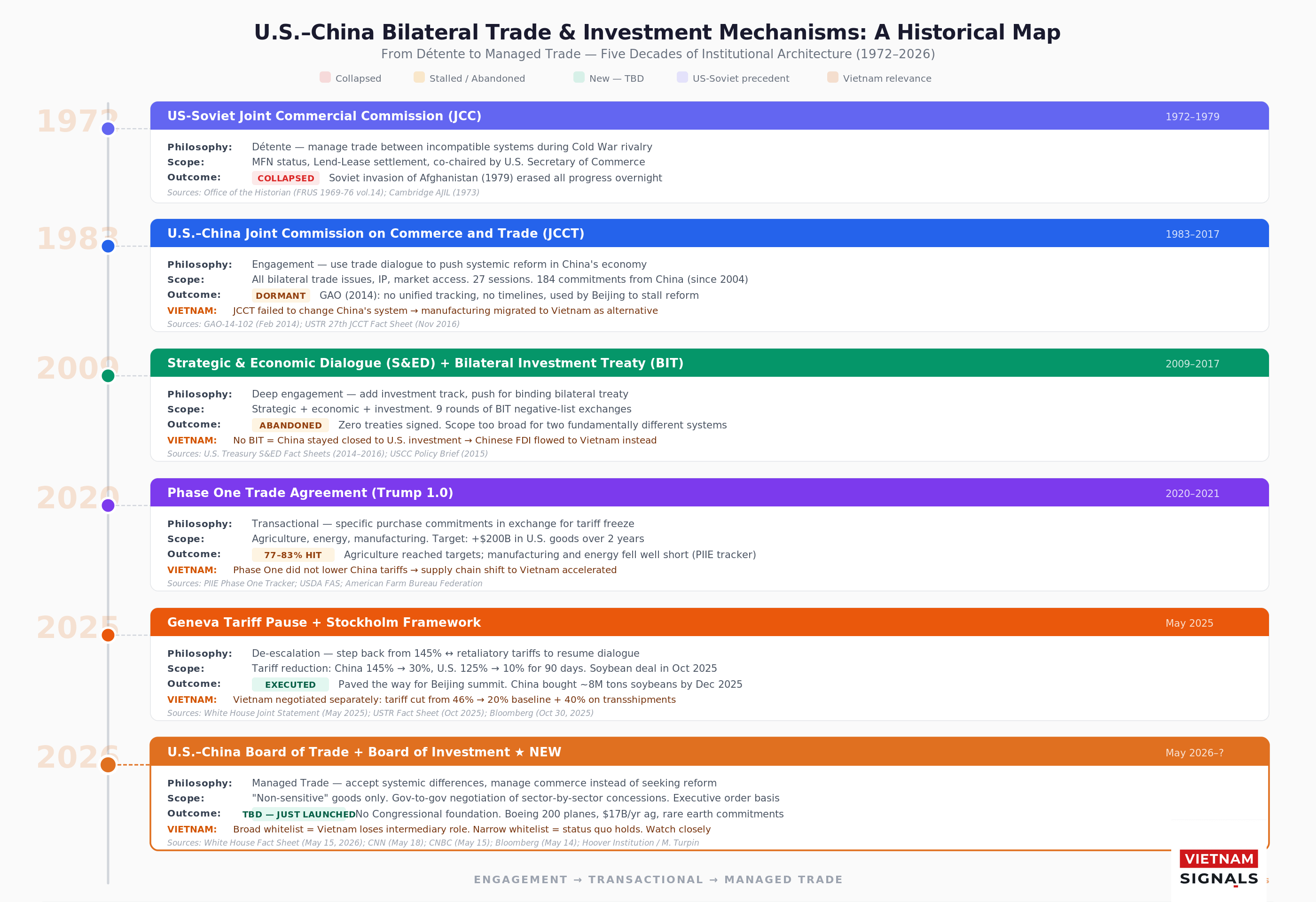
The U.S.–China Joint Commission on Commerce and Trade (JCCT) lasted 34 years and produced 184 commitments, yet an audit by the U.S. Government Accountability Office found that almost none had clear implementation deadlines. Meanwhile, the Obama-era Strategic and Economic Dialogue attempted to negotiate a bilateral investment treaty through nine rounds of talks, only to fail in the end.
Even the US$17 billion agricultural commitment looks unimpressive beside the US$24 billion China actually purchased in 2024. It is merely a partial recovery from the collapse caused by the trade war, not a new peak. Commitments made under the 2020 “Phase One” deal achieved only around 77–83% of targets. Promises of “managed trade” between Washington and Beijing have historically depreciated quickly over time.
More importantly, these new councils rest on executive authority rather than Congressional legislation. Matt Turpin, former China Director at the U.S. National Security Council, argues that this is their structural weakness: any future president could dismantle the entire framework on the first day in office. Businesses planning 20-year factory investments in Vietnam therefore have little reason to panic over institutions that may not survive the first transfer of power.
China itself has also adapted in ways that reduce the incentive to return to the American market. During the trade war, Beijing replaced US$228 billion in lost trade with America through other markets, while Washington replaced only around US$53 billion. The attractiveness of the U.S. market for China’s “non-sensitive” goods is no longer what it was five years ago. In the end, the Board of Trade may simply become a narrow pipeline for soybeans and aircraft engines — sectors in which Vietnam does not directly compete.
The real risk
Vietnam’s greatest vulnerability does not lie in the whitelist or rare-earth concessions. It lies in uncertainty.
When the rules governing the world’s most important bilateral trade relationship can be created or erased through executive orders alone, every long-term factory investment becomes a wager on political continuity in Washington.
These councils may fail like earlier mechanisms. They may succeed just enough to erode Vietnam’s margins in selected industries. Or they may exist largely as diplomatic theatre - generating noise without meaningful economic consequences.
Under any scenario, Hanoi’s task remains unchanged: create deeper real value on the factory floor, move beyond assembly and climb toward higher technical and technological capabilities.
The distance between “assembled in Vietnam” and “engineered in Vietnam” is the distance between vulnerability and resilience. Narrowing that gap is no longer optional. It is mandatory.
Vietnam should also accelerate rare-earth processing capacity now, while Beijing’s concessions are reducing urgency and capital costs remain relatively favourable, rather than waiting for the next crisis. Dong Pao and Nui Phao are strategic assets, but assets without processing capability are ultimately just rocks underground.
At the same time, Vietnam needs to diversify export markets beyond America, which currently absorbs an outsized share of Vietnamese goods. A trade surplus of more than US$130 billion with a single partner is both a source of strength today and a source of vulnerability tomorrow.
The U.S.–China “whitelist” is not a verdict on Vietnam’s future. It is a weather forecast. Hanoi should monitor it daily and plan accordingly, not panic.
Tariff advantages remain. The manufacturing ecosystem continues to improve. And history suggests that mechanisms like these rarely achieve their original ambitions. But Vietnam should also stop assuming that the U.S.–China rift — the very foundation of its recent growth story — will remain frozen forever in precisely the shape most favourable to itself.